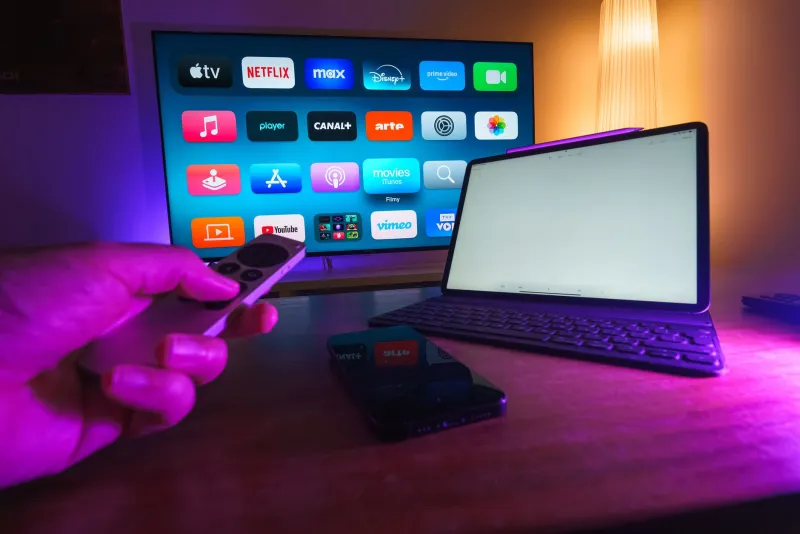
Pluto, Tubi, and the Billion-Dollar Secret Hiding in Your TV's Free Row
Photo: www.hdmi-experte.com, CC BY 4.0, via Wikimedia Commons
Somewhere in your smart TV's home screen, probably a row or two below the apps you actually pay for, sits a selection of channels with names like "TV Land Drama" or "NCIS Universe." They run twenty-four hours a day. They cost nothing. And collectively, they're pulling in billions of dollars a year.
Welcome to FAST — Free Ad-Supported Streaming TV — the fastest-growing corner of the streaming business that almost nobody can name.
What FAST Actually Is (In Plain English)
The concept is almost aggressively simple: linear channels, streamed over the internet, free to watch, funded entirely by ads. It's cable's format married to the internet's delivery, minus the cable bill.
Three players dominate the American market. Pluto TV, owned by Paramount, runs hundreds of themed channels — a whole channel of CSI, a whole channel of Star Trek, a channel that's just Dora the Explorer at all hours. Tubi, under Fox, leans into a massive on-demand library alongside its channel lineup. Samsung TV Plus ships pre-installed on millions of Samsung televisions, meaning a huge chunk of Americans got FAST channels without ever choosing them.
Add in Amazon's Freevee remnants, The Roku Channel, and a swarm of smaller services, and you get a market that analysts now value in the billions — with projections climbing steadily as ad dollars follow eyeballs.
Why Is Nobody Bragging About This?
Here's the strange part: FAST's success is basically an open secret. Ask around and you'll find viewers who watch Pluto daily but have never heard the term "FAST." The services themselves have historically spent surprisingly little on marketing — because, frankly, they don't have to.
The distribution does the work. These channels come pre-loaded on smart TVs, baked into streaming devices, and featured prominently on free tiers of paid platforms. Discovery happens by accident: you scroll past, a familiar show catches your eye, and twenty minutes later you're three episodes deep into a rerun of a procedural you last watched in 2011.
No login. No credit card. No decision fatigue. In a streaming landscape where the average household is juggling multiple subscriptions and growing resentful about it, "free" is a remarkably powerful word.
The Cord-Cutter Full Circle
There's a delicious irony here. Cord-cutters spent a decade fleeing the cable bundle — and FAST is quietly rebuilding it, channel guide and all, minus the invoice.
It turns out a lot of what people hated about cable wasn't the format. It was the price. The experience of flipping on a channel and letting something wash over you — no choosing, no browsing, no decision-making — is genuinely pleasant. Media researchers have a term for it: lean-back viewing. FAST channels deliver that in its purest form, and the audience data shows people, especially those over 45, responding enthusiastically.
For advertisers, it's a bargain: TV-scale reach at streaming-level targeting, reaching viewers who've become expert ad-skippers on paid platforms but sit through ads on free ones without complaint. Free content buys ad tolerance. Everybody in that equation understands the deal.
What This Means for Paid Streaming
The subscription services have noticed, and their response has been telling. Nearly every major streamer now offers an ad-supported tier — Netflix and Disney+ among them — at lower prices. That's not a coincidence. That's FAST logic bleeding upward into paid streaming.
The long-term worry for subscription services is generational: if a household gets comfortable living entirely in the free row — reruns of comfort shows, live news channels, sports highlights — the marginal value of a third or fourth subscription starts looking thin. FAST doesn't need to replace Netflix. It just needs to be good enough to make you think twice about adding another bill.
The Quiet Winner
FAST's rise is a reminder that streaming's story isn't one straight line toward more expensive everything. There's a whole parallel universe growing in the shadows: free, ad-funded, low-glamour, and enormously profitable.
So the next time you're scrolling your TV's home screen, take a look at that free row. There's a billion-dollar industry down there, running around the clock, perfectly content that you don't know its name.
Though now, of course, you do.