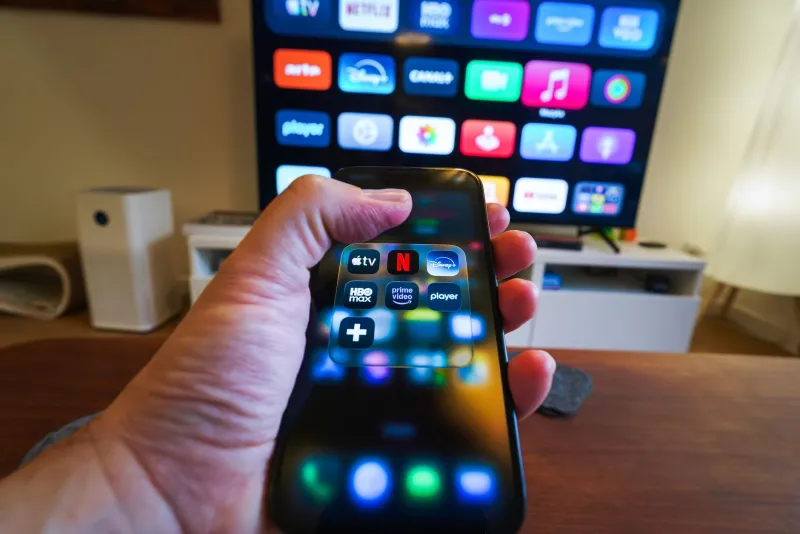
Your Streaming Service Has You Figured Out — And It's Weirder Than You Think

You open Netflix on a Tuesday night with absolutely no plan. You're just browsing. Two minutes later, you're four episodes into a documentary about competitive flower arranging you never would have searched for in a million years. And somehow — somehow — it's exactly what you needed.
That's not a happy accident. That's an algorithm that knows you better than your college roommate does.
Streaming platforms have quietly become some of the most sophisticated behavioral prediction machines ever built, and most of us are just... fine with it? We click play and move on with our lives. But the technology humming underneath that "Top Picks for You" row is genuinely wild — and worth understanding, even if it makes you a little uncomfortable.
It's Not Just About What You Watch
Here's where things get interesting. Platforms like Netflix, Disney+, and Amazon Prime Video aren't just tracking the shows you finish. They're watching how you watch — and the granularity of that data would probably surprise most people.
Netflix has been open about some of this over the years. They monitor things like what time of day you're watching, whether you binge straight through or space episodes out over weeks, how quickly you abandon something after hitting play, and — this one's a little eerie — how long you hover over a title's preview before scrolling past it. That last one is called "preview dwell time," and it's apparently a goldmine of information about your subconscious preferences.
Think about it: you might never click on a gritty prison drama, but if you keep pausing on the preview for three seconds every time it comes up, the algorithm clocks that. It starts building a picture of you that includes the stuff you're curious about but too embarrassed to admit. And then, one day, it just... serves it up at the right moment.
Prime Video takes a slightly different approach, layering in purchase history from Amazon's broader ecosystem. If you've been buying true crime books and noise-canceling headphones, don't be shocked when a docuseries about unsolved murders lands at the top of your feed.
The Machine Learning Behind the Magic
The technical backbone of all this is a mix of collaborative filtering, content-based filtering, and increasingly, deep learning models that can process enormous datasets in real time.
Collaborative filtering is basically the "people like you also liked" approach — it groups viewers with similar behavioral patterns and assumes your tastes will overlap. Content-based filtering looks at the actual attributes of what you've watched: genre, pacing, tone, even the emotional arc of a narrative. Deep learning takes it a step further, finding non-obvious patterns that human engineers wouldn't think to look for.
Netflix famously ran the Netflix Prize back in 2009 — a million-dollar competition to improve their recommendation system by 10%. The winning algorithm was so complex it was never actually fully deployed, but the competition kickstarted an era of serious investment in recommendation AI across the entire industry.
Today, Netflix estimates that its recommendation engine saves the company over a billion dollars annually by reducing subscriber churn. People who feel like the platform "gets" them are far less likely to cancel. That's not a small thing. That's the entire business model.
When the Algorithm Gets It Spectacularly Wrong
Of course, it doesn't always work. And the failures are often more revealing than the successes.
Anyone who has ever let a family member use their profile knows the chaos that follows. Suddenly your carefully curated feed of prestige dramas and cerebral sci-fi is contaminated with animated movies and cooking competition shows. The algorithm, trying to be helpful, starts serving up a bizarre hybrid that satisfies nobody. Netflix eventually introduced profile locks and separate kids' profiles partly to address this, but the underlying problem — that the system assumes one profile equals one human being — still creates weird results.
There's also the "rabbit hole" problem. Recommendation engines are optimized for engagement, not necessarily for your wellbeing or broadening your horizons. If you watch one reality dating show, you might find yourself in a reality TV vortex for weeks, never discovering the nature documentary or foreign film that could've become your new favorite thing. The algorithm is very good at giving you more of what you already like. It's less good at introducing you to something genuinely new.
Some data scientists have called this the "filter bubble" effect — a term more commonly applied to social media, but just as relevant to streaming. You end up in a feedback loop of your own preferences, increasingly insulated from content that might challenge or surprise you.
The Privacy Question Nobody Wants to Have
Let's be honest: most of us clicked "agree" on a terms of service document we never read, and we're now sharing a pretty intimate portrait of our emotional lives with a corporation. What you watch when you're sad, what you put on when you can't sleep, what you binge after a breakup — streaming platforms have all of that, and they're using it.
In the US, streaming services operate under a patchwork of privacy laws that vary by state. California's CPRA gives residents more rights to know what data is collected and to request deletion. But for most Americans, the legal protections are limited, and the platforms' data practices are largely self-regulated.
That said, it's worth noting that Netflix and others have consistently said they don't sell individual viewing data to third parties — at least not in the traditional sense. The data stays internal, used to improve the product. Whether that's reassuring or not probably depends on how much you trust the platforms in question.
What's less discussed is the aggregate power of this data. Streaming services now have a clearer picture of American viewing tastes, emotional patterns, and cultural moments than any network executive ever dreamed of. That shapes what gets greenlit, what gets canceled, and ultimately what stories get told. The algorithm isn't just predicting culture — it's quietly steering it.
So Should You Care?
Honestly? A little bit, yeah.
The convenience is real. A good recommendation engine genuinely improves your viewing experience and saves you from the paralysis of infinite choice. Anyone who has spent 45 minutes scrolling through a streaming library only to rewatch something they've already seen three times knows exactly what problem these systems are solving.
But it's worth occasionally poking the algorithm — searching for something random, browsing a genre you wouldn't normally touch, or asking a friend what they've been watching instead of just accepting whatever the platform puts in front of you. Not because the algorithm is sinister, but because you're more interesting than your viewing history suggests.
The platforms know a lot about you. They just don't know everything. And keeping a little mystery alive — even from a machine — feels like a healthy instinct.
Now if you'll excuse us, we have a documentary about competitive flower arranging to finish.